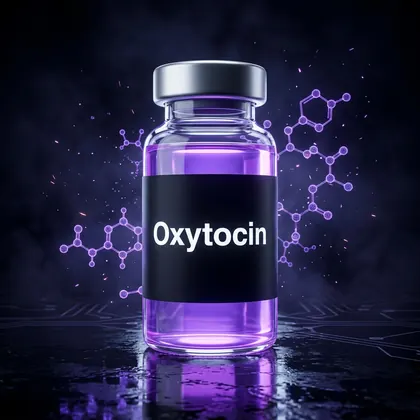
Oxytocin
The bonding hormone. Injectable form used for anxiety, social bonding, and libido.
- Unopened (sealed powder): fridge, or freezer for long storage.
- Once mixed: commonly tracked ~30 days refrigerated (2–8 °C).
- Not medical advice. This is a logbook — log it if you want.
Storage & handling
LYOPHILIZED (unopened): store at 2-8°C (fridge) or -20°C (freezer) long-term. Protect from light.
AFTER RECONSTITUTION: refrigerate 2-8°C. Do NOT freeze. Discard after 30 days OR if the solution becomes cloudy, discolored, or contains particulates.
What Oxytocin is
Oxytocin is a nonapeptide hormone and neuropeptide synthesized in the magnocellular neurons of the hypothalamus and released by the posterior pituitary gland. It primarily exerts its effects by binding to the oxytocin receptor (OTR), a G-protein coupled receptor found in various tissues, including the brain, uterus, and mammary glands. Activation of OTRs initiates intracellular signaling cascades that modulate neuronal activity in regions associated with social cognition and stress, in addition to its peripheral roles. In the bloodstream, oxytocin has a relatively short half-life, typically around 3 to 5 minutes, but its neuromodulatory effects in the central nervous system can persist longer due to local release and receptor binding. It is commonly investigated as a standalone compound, though some studies explore its interactions with other agents influencing neural pathways related to social behavior. This compound is strictly for research purposes and is not intended for human consumption or medical treatment.
What people track
Because individual responses vary so much, the useful thing is your own record: what you logged and when, how much is left in the vial, and how your chosen metrics move over the weeks. Peptide Wizard keeps all of that in one place, alongside a 3D reference vial for Oxytocin.
FAQ
What is Oxytocin?
The bonding hormone. Injectable form used for anxiety, social bonding, and libido.
Is Oxytocin a peptide?
Yes — Oxytocin is a peptide, meaning a short chain of amino acids. Peptides are usually handled as a freeze-dried powder that is mixed with bacteriostatic water before use.
Is Oxytocin a steroid?
No. Oxytocin is not an anabolic steroid. Steroids are fat-soluble hormones built on a four-ring cholesterol backbone; peptides are chains of amino acids and work by signalling to receptors rather than acting directly on DNA in the same way.
How should Oxytocin be stored?
LYOPHILIZED (unopened): store at 2-8°C (fridge) or -20°C (freezer) long-term. Protect from light.
How do I keep track of Oxytocin in my research log?
Peptide Wizard lets you record each entry, keep a vial ledger so you know what's left, and chart your own metrics over time. It is a logbook and reference only — it does not calculate or recommend doses.
How long does Oxytocin last once it is mixed?
As a general convention a reconstituted vial is treated as good for around 28 days refrigerated at 2-8 C, roughly 60 days frozen, and only a few days at room temperature. That figure comes from standard practice for preserved multi-dose vials rather than a test on any single compound, so the instructions supplied with your own vial take precedence. There is a full storage guide at peptidewizard.app/guides/storage/.
Is Oxytocin taken orally or by injection?
Oxytocin is generally handled as sublingual/nasal/subq. Sealed powder is normally kept refrigerated or frozen and mixed with bacteriostatic water when it is going to be used.
What is the difference between Oxytocin and a steroid or a hormone drug?
Oxytocin is a chain of amino acids that signals to receptors. Anabolic steroids are fat-soluble hormones built on a cholesterol backbone and behave completely differently in the body. Neither this page nor the app provides guidance on using either.
How much does Oxytocin cost per dose?
Divide what you paid for the vial by the number of doses in it. A 10 mg vial contains 10 mg, or 10000 mcg, so the number of doses depends entirely on the amount you use. The calculator on this page does the arithmetic, including the doses you lose if the vial expires first.
Is a bigger Oxytocin vial cheaper?
Per milligram, usually yes. Per dose you actually use, not always — a larger vial you cannot finish inside its stability window can work out more expensive than a smaller one you do finish, because the leftover doses were still paid for.
Why is my real cost higher than price divided by doses?
Because a reconstituted vial has a limited usable window, commonly quoted as around 28 days refrigerated. Doses still in the vial when that window closes are wasted, so the honest figure is the price divided by the doses you reach in time.
How long does Oxytocin last once mixed?
Commonly quoted at around 30 days when kept refrigerated. Frozen extends that considerably, provided you freeze it once rather than thawing and refreezing. At room temperature you are counting in days. Purity, buffers and preservatives all change the answer, so the information supplied with your own vial takes precedence.
How long does Oxytocin last in the fridge?
Kept in the fridge at roughly 2-8 C, a reconstituted vial is commonly treated as good for around 30 days. Sealed powder keeps far longer cold. Freezing it once extends the window further still. Purity, buffers and preservatives all shift the real figure, so treat this as a general convention rather than a measured result for this specific compound.
How long can Oxytocin be out of the fridge?
A short spell at room temperature — think hours, or while it warms up before use or is in the post — is generally tolerated, and sealed powder is more forgiving than a mixed vial. Heat is the single biggest cause of degradation, so the warmer it is the shorter the safe window, and days left warm is a different matter to a brief excursion. Keep it away from direct light too.
Does Oxytocin need to be refrigerated?
Once reconstituted, refrigeration is the normal recommendation, and heat is by far the biggest cause of degradation. Sealed lyophilized powder is more tolerant but still keeps best cold and away from light.
Can I freeze Oxytocin?
Freezing once is generally considered fine and extends the usable window. Repeated freeze-thaw cycles are what cause damage, so splitting into smaller amounts before freezing means you only thaw what you need.
How do I tell how old my Oxytocin vial is?
Write the date you mixed it on the vial, or record it in a tracking app. Without that date there is no reliable way to know, which is the most common reason a vial gets used past its window or thrown away early.
Never lose the mix date again
The usual reason a Oxytocin vial gets thrown out early — or used past its window — is that nobody wrote down the day it was mixed. Log the vial once and Peptide Wizard counts the days for you, then flags it before it expires.
▶ Start free in your browserGet the appWhat a dose of Oxytocin costs
Vials are priced per vial, but you use them per dose. Oxytocin is most commonly sold as a 10 mg presentation. Put in what you paid and the amount you use, and this works out the real figure — including the doses you lose if the vial expires before you finish it. Nothing is stored or sent anywhere.
Pro warns you before a vial expires. First month free.
Reference arithmetic only. The dose figure is whatever you enter — this site does not suggest one.
A smaller vial sometimes works out cheaper per dose than a larger one, even when the larger one looks better per milligram, because a vial you cannot finish inside its stability window still had to be paid for in full. If the box above shows waste, try a smaller vial size and watch the real figure move.
How long Oxytocin lasts once mixed
The clock starts when you mix it. Reconstituted Oxytocin is generally quoted at around 30 days refrigerated, roughly 60 days frozen if frozen only once, and a few days at room temperature. Sealed powder keeps far longer. Enter the date you mixed it for an exact expiry date.
Reference only — purity, buffers and preservatives all change the answer, so the storage information supplied with your own vial takes precedence. Full method and sources in the shelf life reference table.
Four things do the damage, in rough order: heat by a wide margin, then light, then repeated freeze–thaw cycles, then agitation. Swirl a vial to mix it rather than shaking it, and keep it in its box away from light.
Oxytocin compared with…
More in Cognitive
 CerebrolysinComplex of neuropeptides derived from porcine brain.
 CortagenShort brain-tissue-derived bioregulator peptide.
 DIHEXANeurogenic peptide.
 DSIPDelta Sleep-Inducing Peptide.
Handling questions
Mixing, filtering, storage and disposal are the same job whatever is in the vial. Search the guides and land straight on the answer.
Can I shake it? · It went cloudy · Should I filter? · Fridge or freezer? · Travelling with vials
Use this on your own site
Writing about Oxytocin? Take the calculator rather than retyping the maths — it is free and needs no account. Grab the embed code.
Citing this page: “Oxytocin — storage, shelf life and handling”, Peptide Wizard, peptidewizard.app/peptides/oxytocin/. Corrections welcome at support@peptidewizard.app — every claim here is sourced and we would rather fix it than defend it.
This page is educational. It does not contain dosing guidance and is not medical advice.