Home › Compare › Humanin vs SS-31 (Elamipretide)
Humanin vs SS-31 (Elamipretide)
Humanin and SS-31 (Elamipretide) are both longevity peptides, which is why they get recommended interchangeably — but they are different compounds with different origins. The table below sets out the differences. We give no dosing guidance.
Side by side, in plain English — what each one is, where they overlap and where they genuinely differ.
 HumaninLongevity
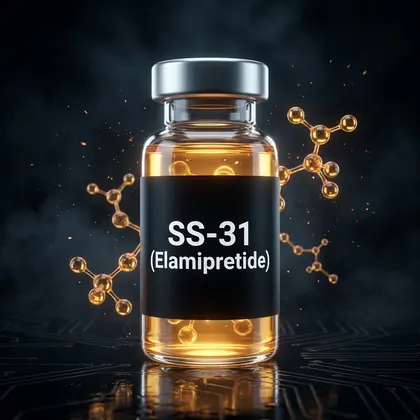 SS-31 (Elamipretide)Longevity
At a glance
| Humanin | SS-31 (Elamipretide) | |
|---|---|---|
| Category | Longevity | Longevity |
| Typical route | SubQ | SubQ |
| Shelf life once mixed | ~30 days | ~30 days |
The differences that actually matter
Both are classed as Longevity peptides, so they get compared constantly and are often researched for overlapping reasons.
What Humanin is
It is understood to exert its biological effects through interactions with various cellular components, notably by binding to certain cell surface receptors such as components of the ciliary neurotrophic factor (CNTF) receptor complex, including CNTFRα, gp130, and LIFRβ. Furthermore, it is reported to interact with insulin-like growth factor binding protein 3 (IGFBP-3), thereby influencing downstream signaling pathways. It is important to remember that Humanin is a research peptide and its use is strictly for scien
What SS-31 (Elamipretide) is
SS-31, also known as Elamipretide, is a small, aromatic-cationic peptide designed to selectively target mitochondria. It primarily localizes to the inner mitochondrial membrane where it interacts with cardiolipin, a unique phospholipid essential for mitochondrial structure and bioenergetics. By binding to cardiolipin, SS-31 helps to stabilize the inner mitochondrial membrane, protect it from oxidative damage, and preserve the integrity of the electron transport chain. While its plasma half-life is relatively brief,
How to compare them for yourself
Anecdotes online are noisy because nobody is measuring the same thing. The only comparison that means anything is your own: log each entry with a timestamp, keep the vial ledger honest so you know what you actually got through, pick two or three metrics before you start, and look at the trend after several weeks rather than day to day.
Peptide Wizard does that part for you — Humanin and SS-31 (Elamipretide) are both in the built-in reference library with a 3D vial, and your history, vial ledger and cost per entry stay private on your device.
FAQ
What is the difference between Humanin and SS-31 (Elamipretide)?
Both are classed as Longevity peptides, so they get compared constantly and are often researched for overlapping reasons.
Can you log Humanin and SS-31 (Elamipretide) in the same period?
Plenty of people record more than one peptide at a time. Peptide Wizard keeps a separate vial ledger and entry history for each, so you can see exactly what overlapped and when — it does not recommend combinations or doses.
Which is better, Humanin or SS-31 (Elamipretide)?
There isn't a universal answer — reported responses vary a lot between individuals, which is why your own log is more informative than anyone else's anecdote. Track one variable at a time and compare your own metrics over several weeks.
Is this medical advice?
No. This page is educational reference material only. It contains no dosing guidance. Speak to a qualified healthcare professional before making any decisions.
Handling questions
Whichever you pick, mixing and storage work the same way. Search the guides and land straight on the answer.
Can I shake it? · It went cloudy · Should I filter? · Fridge or freezer?
Educational reference only. This page contains no dosing guidance and is not medical advice.